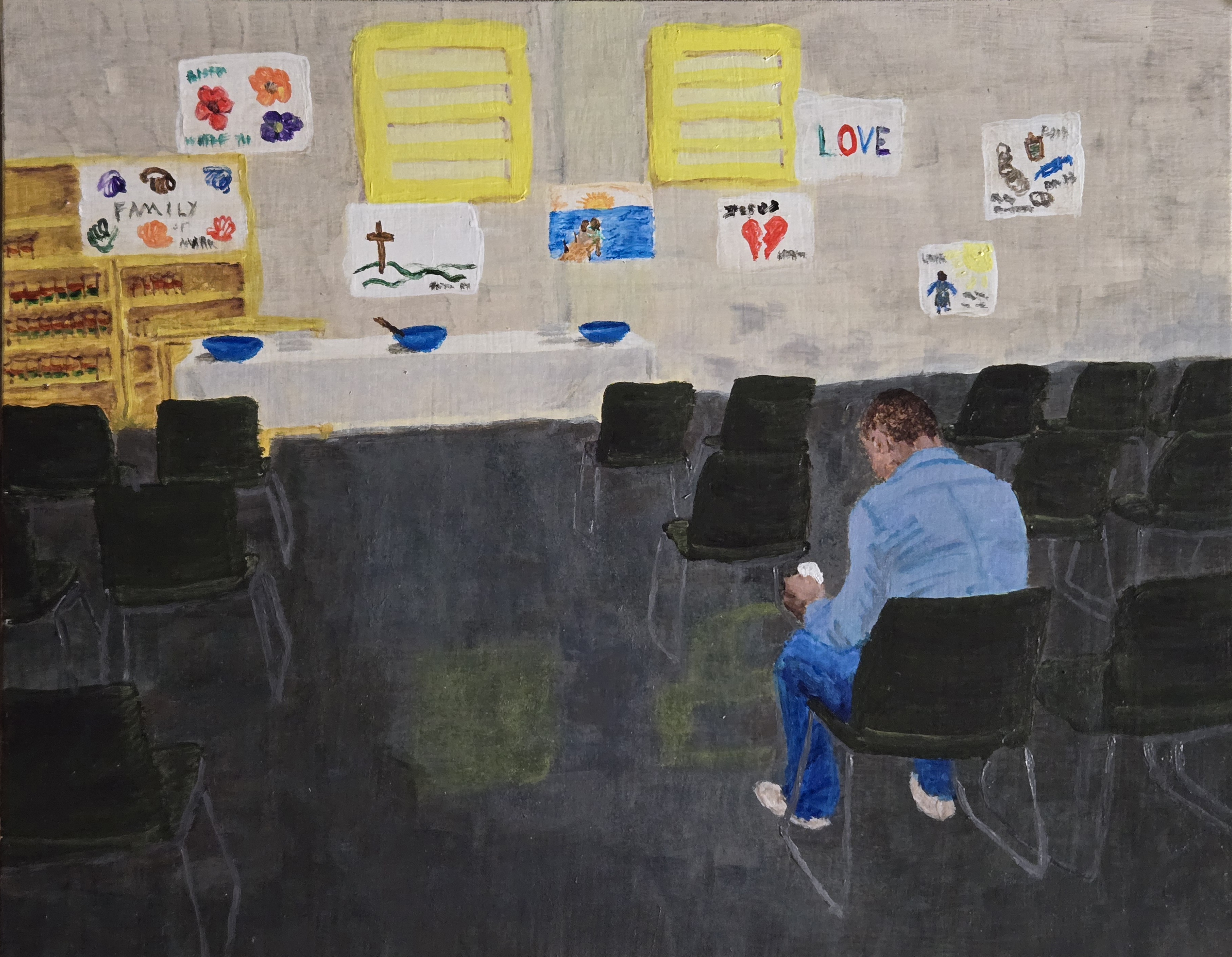
This painting, “The Moment,” represents a point in time when men are given the opportunity to make a decision—an opportunity to accept a new identity filled with hope, love, acceptance, forgiveness, belonging, and meaning.
This moment is overwhelming, and this moment is terrifying.
For some, these are words and feelings they haven’t felt for a long time. For others, these are feelings that they have never felt; they are foreign, uncomfortable, and unknown. On the street and behind bars, the unknown is dangerous.
It would be so much easier and safer to let this moment go—to go back to the cell and pretend the last two days never happened. But they did happen, and the men know they will never, until their dying day, be forgotten.
The vast majority of incarcerated men in the US were, themselves, victims of abuse. Studies show that up to 79% have been victims of physical abuse, 26% have been victims of sexual abuse, up to 72% have had family members or close friends die violent deaths, up to 87% have suffered a traumatic brain injury (TBI), and 30 to 60% have post traumatic stress disorder (PTSD). The exact numbers vary by study, but the differences do not matter: these traumas go untreated.
People suffering like this grow up believing they are inherently flawed, unlovable, or broken. They learn to develop a multitude of masks—as protection—to hide who they are. Eventually, they no longer know who they are themselves. They are left with a profound sense of emptiness and a weak, unstable core identity. This kind of pain is too much to endure, so they learn emotional numbness. The constant fear that others may discover their weakness leads them to overcompensate by being tough and cold. If you don’t do this well, you are devoured. If you do it too well, you are totally alone—totally unlovable, because you cannot be loved if you cannot be known.
And so, eventually, you end up in jail. The courts remind you that you are feared, hated, and despised. Once behind bars, you are forgotten. Family may fade away. Former friends and classmates may remain prominent in your mind—your last memories of freedom, the last time you meant something to anybody. But in their minds, you are a fading memory, perhaps a disappointment, or more likely, not even a recollection.
And you are alone. One year, two years, five years, ten, twenty.
Some know they will never get out, their bodies destined for an unmarked pauper’s grave. Others hope to get out someday, but inside they realize there is no one waiting—nothing but cold streets and homeless shelters when their bodies are too old to endure such a life for long.
Kairos is a Christian prison ministry made up of volunteers who have not forgotten these men. Year after year, Kairos sends teams of men into local prisons to host retreat-like weekends behind bars. For three and a half days, the team sits with them, eats with them, shares with them, and listens to them. Countless others make posters of joy and hope to be displayed on the walls—so many that by the end of the weekend, every wall is covered in a visual display of love.
Kairos shows these men, many for the first time, what the overflowing agape love of Christ is. Feeling these feelings is strange. At first, it is just different, which in prison means a lot. Then it is fun—a good time. But then, it starts to change.
They start to realize that these guys who came in truly care about them. No one cares about them, but these men do. And they listen. Then they share their own stories and their own pain. All of a sudden, these volunteers aren’t so different from the men hiding inside—the men behind all the masks and bravado.
A seed of a thought starts growing: These Christian men are okay being who they are. They feel loved and appreciated for who they are. They aren’t afraid to share their weaknesses, and this lack of fear makes them stronger. And they are just like me. The inside me. The hidden me. The lonely me. The suffering me.
Then they begin to realize that to these Christian men, the masks aren’t really working. These volunteers see the things behind the mask that the inmates themselves have been afraid to face. But they aren’t repulsed; they are welcoming, caring, and inviting.
Suddenly, the weekend isn’t so fun anymore. It’s scary. For the first time in a lifetime, the thought floats into their heads that their identity can change.
This begins a mental war between hope and fear. There is the hope that they could live a life of joy, that they could experience the transcendent sense of peace these men wear like comfortable old sweaters, and that they could have a real friend—someone who they could lean on in times of need, or whom they could support.
But the journey to peace means removing the masks and looking under each one. It means reliving memories that they have worked so hard to suppress, reliving past failures, and remembering those they hurt. Really remembering.
The risk exposes their weaknesses for all to see. Is the gamble worth it? Their prison reputation could be shattered, and they know what that could mean.
But the posters are real. The conversation was real. The joy was real, and the feeling of love was real.
While the battle rages in their minds, one of the outside Christian men hands them a small slip of white rice paper.
“Write down the names of people from whom you need forgiveness. And write down the names of the people whom you need to forgive. All of them.”
The paper is for a simple forgiveness ceremony. Various Christian groups have done forgiveness ceremonies for two thousand years. The logistics are simple: when the time comes, you simply walk up and drop your slip into a bowl of water. As you see the names dissolve away, you know that in God’s mercy, these past hurts and sins dissolve away also. A new life can begin.
So, it isn’t a simple slip of paper. It is a choice between two radically different lives. It is a choice between living out the rest of your days in the comfortable isolation of your masks, or remembering all the people, all the pain, all the hurts, and letting it go.
In reality, the room is crowded, and the prison is noisy. But in reality, there is nothing in the world but an empty slip of paper and a decision.
This is the moment.